  |


| ||||
|
| ||||
|
|
Dimensions and Exterior Design I guess the first thing that I noticed about this particular model was its size -- the overall dimensions are 13.0 x 4.2 x 2.5 cm. Comparing to the Nokia 5120, 5190, 6190, the phone is the same height and about the same thickness, but up to 0.5-1.0 cm narrower. The SCP4000 has a retractable antenna, a indication LED on the top of the phone, and a blue/cyan backlighting on the display screen. The screen lighting is called "Clearglo", and I have to pause and think if Telus Mobility/Clearnet was partially influenced to carry this model based on the name of the backlighting display. Menu navigation is controlled by a central scrolling key, similar to the Mitsubishi G75. Besides the standard numeric keys, four keys surround the scrolling key (OK, Clr, Talk, End) and a separate row of keys at the bottom of the phone control the power and volume settings.
The phone fits comfortably in your hand and overall the handset is very light at 133 grams. Navigation through the menu options and dialing numbers was relatively easy. Although the narrower design of the phone required smaller keys, the softkeys were easy to hit and are coated with a gripping material that prevents slippage. Being a dual mode phone, the Sanyo SCP4000 supports both 1900 MHz CDMA and 800 MHz AMPS. Telus Mobility/Clearnet PCS, as with other prior phones, has the phone automatically use their digital CDMA network where such a network is present (Victoria, Vancouver, Calgary, Edmonton, Greater Toronto, Windsor, Ottawa, Montreal, Quebec City, etc.). If no CDMA network is available, the phone will use AMPS (analog) service. This combination of technologies ensures that you will be able to use this model in most places in Canada that have either Telus Mobility/Clearnet PCS digital services or Rogers analog services. For Sprint PCS users, this phone will work in most major centres in the US where Sprint PCS has set up digital services. This model will also access AMPS services when CDMA is unavailable. The SCP4000 definately has a preference for digital over analog signals. This means that the digital signal must be very weak before it establishes an analog connection. I am not fully impressed with the analog portion, which may take a full 30 seconds or longer to establish once digital is lost OR on inital boot-up in an analog-only area. The phone also experienced a higher analog drop rate when compared to my Sony. This would be a primary concern to users that are either in fringe digital areas or analog-only areas.
This handset is available in Canada at Telus Mobility/Clearnet stores, electronics stores (e.g., Future Shop), drug stores (e.g., London Drugs), and cell phone stores. The selling price is $100, which may include an in-store bonus gift or rebate (varies between retailers).
All menu options are controlled via the central scrolling key. Moving the scrolling key up or down selects individual menu options. Hitting the scroll key to the left gives your page and text (SMS) messages; hitting to the right puts you into your phone book. I like how the phone book is laid out. You enter a name and then the number of the person. You then can select a label to go with the phone number (Home, Work, Mobile, Pager, Data, Fax, or None). When you recall someone's name, the directory lists ALL the numbers associated with that name. This is much nicer than having separate phone book entries for each number. No answer at home? Scroll down one to the work number or two to the cellular number. You have have up to 300 phone number entries in the phone book. You can also associate up to eight numbers with speed dialing.
The sound volume on this small handset is very good. Even in noisy environments the speaker was still easy to hear and there was very little distortion at the highest setting. The highest Sanyo speaker volume is on par with the highest volume setting on Telus Mobility/Clearnet's Sony phone. Volume is controlled from the bottom of the phone, which means that you'll have to use your other hand or a skilled pinky to change the setting during a call (many other phones have the volume controlled by the scrolling softkey). The ringing and alert tones are loud as well, but not as loud as other handsets on the market. The loudest ring volume on the Sanyo compares to the medium ring volume on both the Sony and almost any of the Nokia 51xx or 61xx models. This maximum volume setting may not be a concern if the phone will be sitting in the open or in a shirt pocket; it may present a problem if the phone usually sits deeper inside a briefcase, pack, or in a noisy environment.
The included lithium ion battery will get up to three hours talk time and up to 4.5 days in digital mode and under ideal conditions . The included battery is also quite small (5.0 x 3.0 x 1.0 cm) and lightweight. The included phone charger is also small (6.5 x 4.5 x 2.5 cm) and lightweight and even has a folding plug. Good design!
One very nice phone! Very small, lightweight, and easy to use. A couple of minor problems with the display viewing in the absence of backlighting (e.g., for the included game) and the quieter ring volume, but these are definitely outweighed by all the great features on the phone. I really like the idea of grouping up to seven different numbers with one name and easily choosing between the numbers once you have the name on the screen. Clearnet and Sprint customers are going to have a tough choice between this phone and the Nokia 6185/8. Field Test From the main screen enter in the following order: Display, OK, 0 (zero), then enter the field debug test code. For Telus Mobility this code is 000000, for Sprint PCS this code is 040793, for older Telus Mobility/Clearnet PCS handsets this code is 183729.
Steve Punter: http://www.arcx.com/sites/Sanyo SCP-4000.html Howard Chui: http://www.howardchui.com/phonereviews/sanyo40001.htm
| 
| 
|
| ||||||||||||||||||||||||||||||||||||||||||


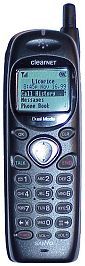 The new Sanyo SCP4000 was available starting in November 1999. This is a review of this dual mode 1900 CDMA/AMPS model that is sold for use on both the Telus Mobility/Clearnet PCS network in Canada and the Sprint PCS network in the US. Tested was version 2.0026CN; PRL 0002.


